

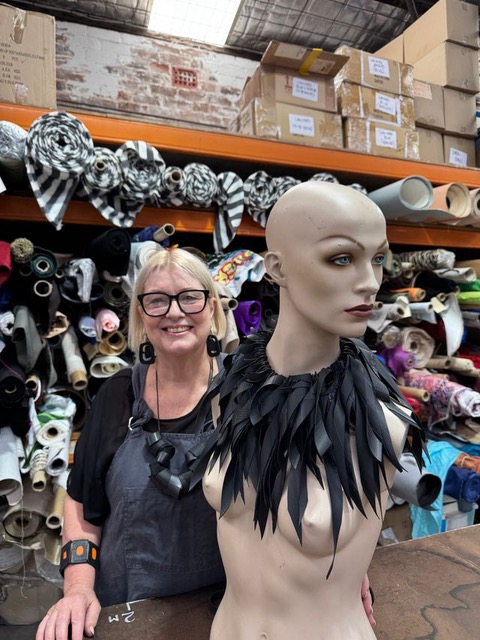
Creativity and sustainability go hand in hand for Alison Breen, the designer behind Studio52, a jewellery brand that transforms industrial discards into striking contemporary accessories.
What inspired you to start creating jewellery from industrial discards, and how did Studio52 come to life?
I’ve always been a maker, and I’ve always enjoyed creating something interesting and beautiful from unusual materials. In the 80s I designed and sold ‘recession dressin’ clothing at Paddington Markets which was largely made from dissected vintage clothing, calico, potato prints and inside-out frayed visible seams. It was a lot of fun! The creative spontaneity and challenge of producing those pieces using repurposed materials during that period was really liberating and so my 2023 resolution was to return to design with that kind of creative abandonment. Despite having a sewing background, I wanted a completely new creative venture, so I played around and fell in love with making costume jewellery and right from the get-go that happened using items from RG. At the time RG had a huge amount of rubber strips so that sparked my fascination with rubber and from there I sourced rubber inner tubes and also started exploring a variety of discarded plastic items. As soon as I began looking through that repurposing lense, I became a kid in a lolly shop, and Reverse Garbage is that lolly shop!
Sustainability is a key focus for Studio52. Why is it important for you to create jewellery that contributes to reducing waste?
Thankfully the fashion community seems to be having a moment of awareness regarding waste and the environmental harm fashion production is creating but jewellery generally doesn’t feature in that discussion, but it is a waste contributor and sadly most costume jewellery will be binned over time with very little recycling taking place.
Personally I love the challenge of repurposing materials not originally intended to be used for fashion and taking a salvaged industrial material and transforming it into a contemporary piece of jewellery that creates interest and also has a history, so for me sustainability is a positive part of the creative venture and not really a hurdle to overcome.
Anyone visiting Reverse Garbage will be confronted by an incredible array of fascinating discarded industrial cast offs, but it’s also a visual reminder of just how much waste there is out there, so repurposing materials and helping reduce waste, even just a teeny bit, is a no-brainer for Studio52. At the end of the day, I would love to leave my children a better future than the one currently on offer so ensuring Studio52 is a sustainable brand was always the only option.

How does Reverse Garbage play a role in sourcing materials for your designs? Do you have any favourite finds from RG?
I find my inner tubes from local bike repair shops, and tractor inner tubes from repair shops that are way too far from my studio! But I dare say I wouldn’t have been able to create Studio52 in its current form if it wasn’t for Reverse Garbage as pretty much everything else that I use in Studio52 designs are from RG.
I have sooo many favourite RG finds! I found a bunch of thin plastic ‘exit’ sign inserts which have a great urban industrial vibe .. I’ve used it many times in earrings, rings and necklaces. Another great score was a pile of silver plastic box inserts that I’ve transformed into bling-y earrings and necklaces that give off BIG party energy!
You’ve mentioned the staggering number of bicycle inner tubes that end up in landfills. How do you hope your work raises awareness about these issues?
Bicycle and other vehicle inner tubes have limited options for recycling and they’re actually an incredibly interesting material for fashion repurposing. They’re fun, bouncy and have their own personality depending on how they’re cut, coloured, hung or wrapped! Happily there are now organisations in Australia that charge bicycle shops to collect and recycle them into things like flooring for playgrounds but so many are still tossed directly into the landfill bin. I hope that by seeing what incredibly interesting properties things like inner tubes have when they are recreated as jewellery, people will understand that items that are no longer fit for purpose might have other uses to extend the life of that object. I mean who would have thought a rubber bicycle tube could be transformed into an outrageously glamorous necklace?!
You can see more of Alison’s creations at https://studiofiftytwo.com.au